Aramid-Carbon Mixed Fabric: Engineered Hybrid Reinforcement
As a Aramid-Carbon Mixed Fabric Suppliers, we match product configuration to the application, operating limits, interfaces and acceptance criteria defined for each project.
As a dedicated Aramid-Carbon Mixed Fabric manufacturer, Jiangyin Dongli New Materials Technology Co., Ltd. produces hybrid woven fabrics that combine the high tensile strength and modulus of carbon fiber with the impact resistance and toughness of aramid fiber. Our fabrics are designed for demanding applications where lightweight, durability, and energy absorption are critical.
Operating from a 32,000-square-meter facility in Jiangyin, China, we control the entire production chain—from weaving to surface treatment—ensuring consistent quality and traceability. Our range includes plain, twill, and custom-pattern weaves in various fiber counts and color combinations, tailored to meet specific engineering requirements.
Why Choose Hybrid Aramid-Carbon Fabrics?
Pure carbon fiber offers exceptional stiffness but can be brittle under impact. Aramid fiber provides high toughness and energy absorption but has lower compressive strength. By interweaving these fibers, we create a material that balances rigidity and ductility, offering:
- Enhanced impact resistance: Aramid's ductility absorbs impact energy, preventing catastrophic failure.
- Improved fatigue life: Carbon fiber resists creep, while aramid handles cyclic stress, ideal for dynamic loads.
- Weight reduction: Hybrid fabrics achieve high specific strength, reducing component weight compared to metals.
- Thermal stability: Aramid withstands high temperatures (decomposition >500°C), complementing carbon fiber's thermal conductivity.
Our Product Range
We offer a variety of aramid-carbon mixed fabrics to suit different applications. Each weave pattern and fiber ratio can be customized based on your performance targets.
| Product Type |
Fiber Composition |
Typical Applications |
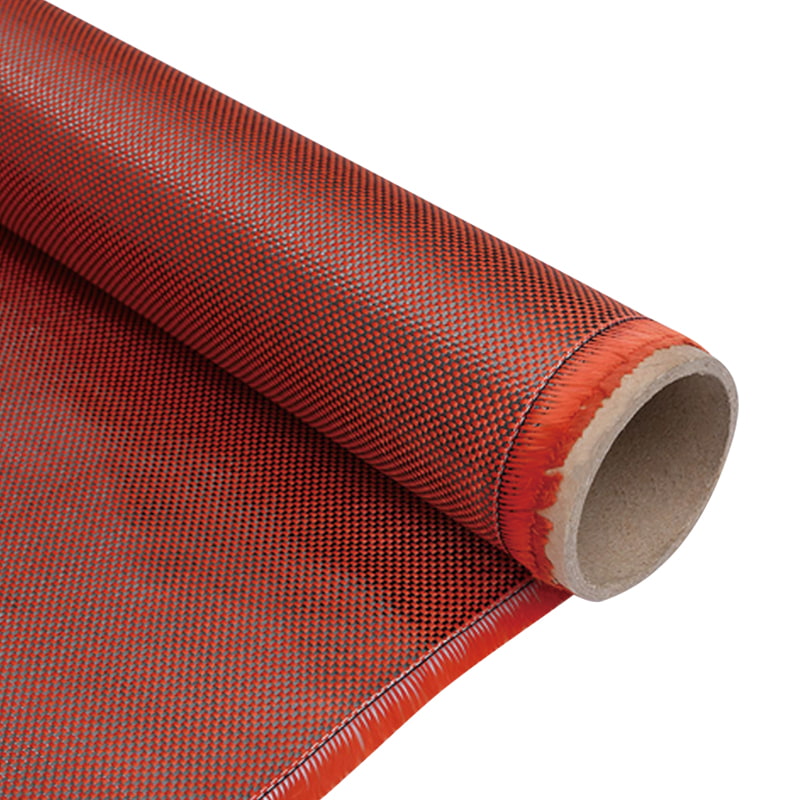
| Red/Black Aramid-Carbon Fabric |
Aramid (yellow/red) + Carbon |
Automotive trim, protective gear, sporting goods |
| 3K 1000D/1500D Plain/Twill |
3K carbon + 1000D/1500D aramid |
Aerospace interiors, drone frames, high-performance parts |
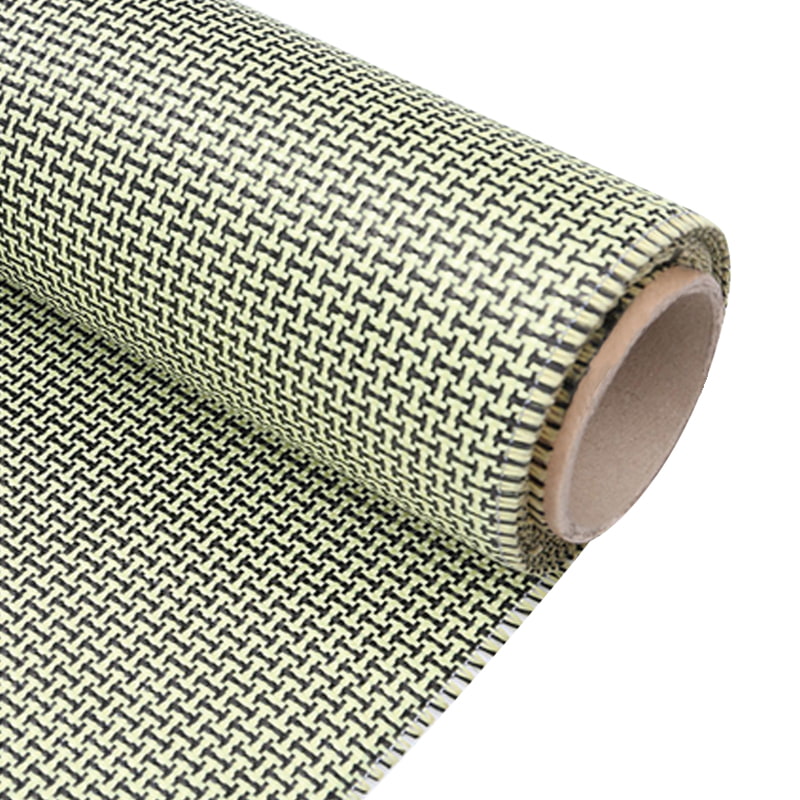
| Yellow/Black I-Beam Pattern |
Yellow aramid + black carbon |
Decorative structural panels, automotive body kits |
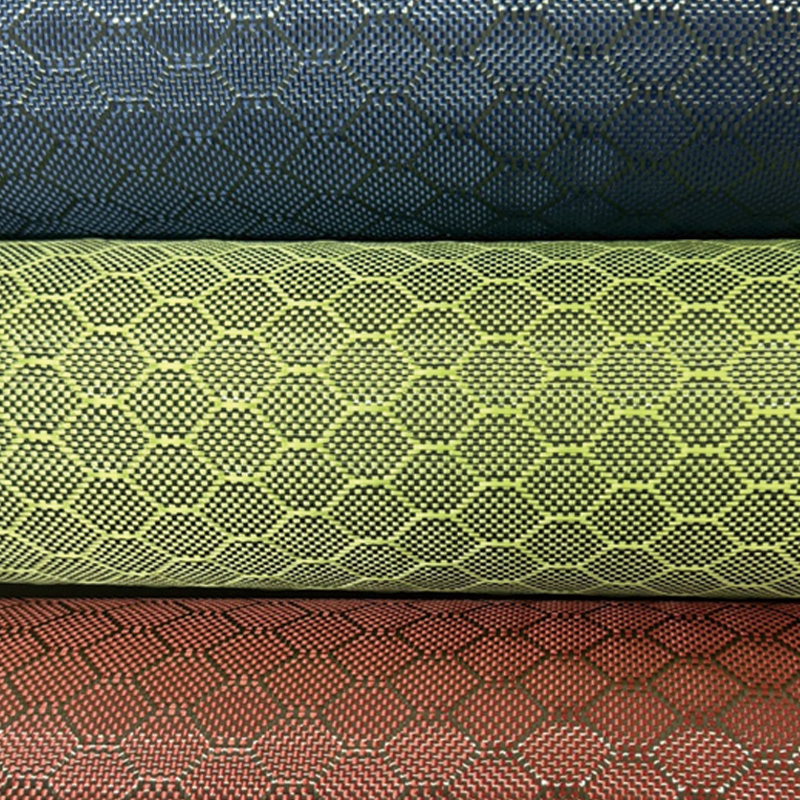
| Football Pattern Blend |
Aramid + carbon with unique pattern |
Custom aesthetic components, consumer electronics |
Application Fit by Industry
Our hybrid fabrics are engineered for sectors where performance cannot be compromised:
- Aerospace: Helicopter rotor blades, aircraft interior panels, and UAV structures benefit from the combination of carbon's stiffness and aramid's bird-strike resistance.
- Automotive: Body panels, crash structures, and battery pack protective layers use these fabrics to reduce weight while improving collision energy absorption.
- Sports Equipment: Helmets, skis, and bicycle frames require materials that withstand repeated impacts without adding weight.
- Protective Gear: Ballistic vests and shields rely on aramid's energy absorption, enhanced by carbon's rigidity to prevent deformation.
Technical Specifications and Customization
We understand that every project has unique requirements. Our fabrics can be customized in terms of:
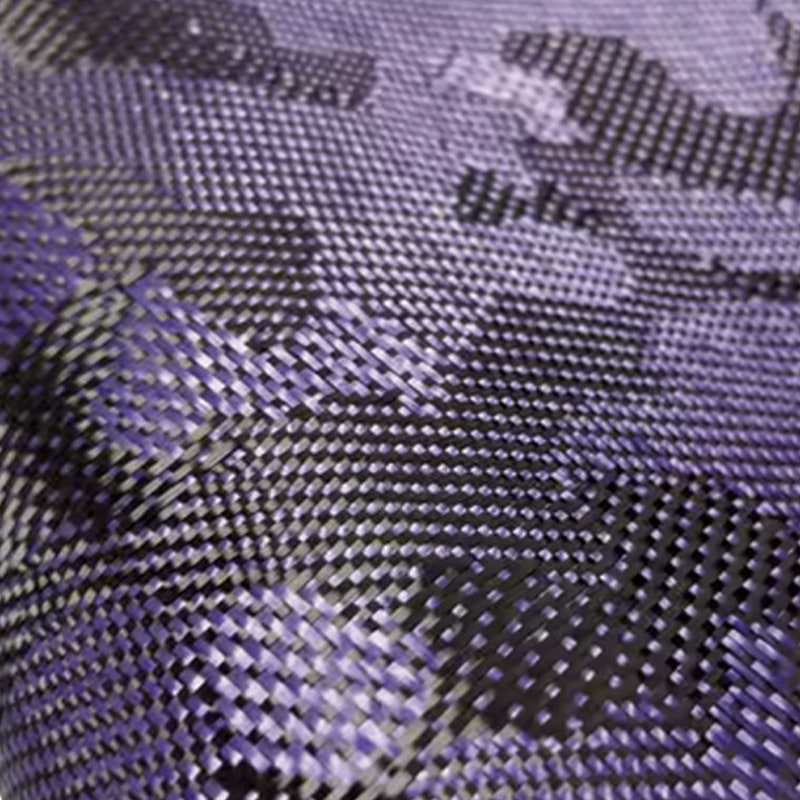
- Weave pattern: Plain, twill, satin, or custom designs like football or I-beam.
- Fiber count: 1K, 3K, 6K, 12K carbon combined with various aramid deniers (e.g., 1000D, 1500D).
- Width and roll length: Standard widths up to 1000mm, with custom widths available.
- Surface finish: Options include dry fabric for resin infusion or pre-impregnated (prepreg) versions.
Our in-house weaving equipment ensures precise tension control, resulting in uniform fabric structure and consistent mechanical properties. We also offer Carbon Fiber Woven Cloth and Aramid Fiber Woven Fabric for projects requiring single-fiber solutions.
Quality Assurance and Compliance
Our manufacturing processes are ISO 9001:2015 certified, ensuring rigorous quality control from raw material inspection to final product testing. Each batch is tested for:
- Tensile strength and modulus
- Areal weight and fabric count
- Impact resistance (where applicable)
- Thermal stability
We provide material certificates and test reports upon request, supporting your compliance and documentation needs.
Integration with Composite Processes
Our fabrics are compatible with common composite manufacturing methods, including:
- Hand lay-up and vacuum bagging for prototyping and low-volume production.
- Resin transfer molding (RTM) for high-volume, complex shapes.
- Autoclave curing for aerospace-grade components.
- Compression molding for automotive parts.
If you need prepreg materials, we also produce Prepreg with epoxy or cyanate ester resins, offering controlled resin content and tack for automated lay-up.
Information We Use to Configure Your Solution
To prepare an accurate quotation and technical proposal, please provide the following details:
- Target application and operating environment (e.g., temperature, impact loads)
- Required mechanical properties (tensile strength, modulus, impact energy)
- Fabric dimensions (width, length, roll size)
- Weave pattern preference and fiber count
- Resin system if prepreg is needed
- Production volume and delivery timeline
Frequently Asked Questions
What is the typical lead time for aramid-carbon mixed fabric orders?
For standard fabrics, delivery is typically within 20 days after order confirmation. Custom weaves or prepreg versions may require additional time, which we will confirm in our quotation.
Can you match a specific color or pattern for branding purposes?
Yes, we can customize the color combination and weave pattern to match your design requirements. Our football pattern and I-beam designs are examples of custom aesthetics we can produce.
Do you provide technical data sheets and test reports?
Absolutely. Each shipment includes a material certificate and, upon request, detailed test reports covering mechanical and thermal properties.
What is the maximum fabric width you can produce?
Our looms can produce fabrics up to 1000mm wide. For wider requirements, we can discuss custom solutions or recommend joining methods.
Are your fabrics suitable for outdoor applications?
Aramid fibers are sensitive to UV degradation. For outdoor use, we recommend protective coatings or laminates. We can advise on suitable surface treatments based on your application.
 中文简体
中文简体 عربى
عربى Tiếng Việt
 Get In Touch
 English

 +86-13961668677
 No. 61, Xingyuan Road, Jiefang Village, Gushan Town, Jiangyin City, Jiangsu Province, China.