Epoxy Carbon Fiber Manufacturers
We are Jiangyin Dongli New Materials Technology Co., Ltd., a China-based Epoxy Carbon Fiber Manufacturers and one-stop factory. Since 2018, we have operated from a 32,000-square-meter complex with climate-controlled workshops and 100,000-grade purification zones, producing high-performance prepregs that serve as the critical intermediate for advanced composite parts. Our range covers epoxy and cyanate prepregs, engineered for aerospace, automotive, sports equipment, and industrial applications where weight reduction and structural integrity are non-negotiable.
As a vertically integrated manufacturer, we control every step from fiber weaving to pre-impregnation, ensuring consistent resin content, tack, and out-life. Our prepregs are used in autoclave, RTM, and compression molding processes, and we support customers from material selection through to production trials.
Our Prepreg Range
We supply two primary prepreg families, each tailored to specific performance and processing requirements:
Epoxy Prepreg
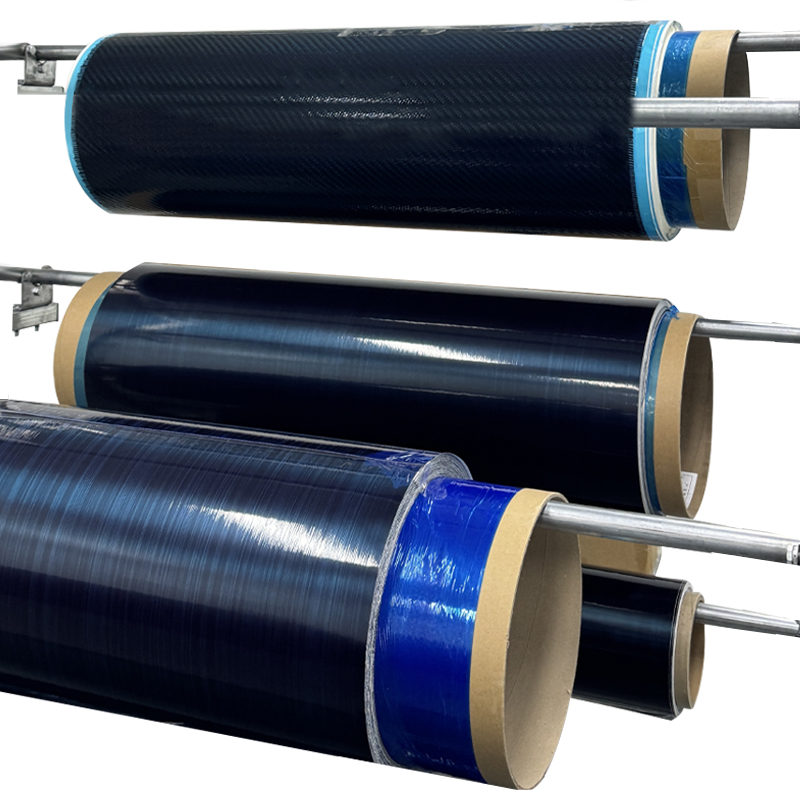
Our Epoxy Prepreg combines carbon or glass fiber with toughened epoxy resin, offering high strength, excellent adhesion, and good storage stability. It is the workhorse for structural components requiring balanced mechanical properties and ease of handling.
Cyanate Prepreg
Our Wholesale Cyanate Carbon Fiber Prepreg Suppliers line uses cyanate ester resin, providing superior thermal stability, low moisture absorption, and excellent dielectric properties. Ideal for high-temperature aerospace and electronics applications.
Application Fit and Material Considerations
Choosing the right prepreg depends on your part’s operating environment, mechanical loads, and curing capabilities. We help you match the resin system to your needs:
- Aerospace: Cyanate prepregs for radomes, engine components, and satellite structures requiring low outgassing and high-temperature resistance.
- Automotive: Epoxy prepregs for body panels, chassis components, and battery enclosures where fast cure cycles and impact resistance are key.
- Sports Equipment: Epoxy systems for bicycle frames, tennis rackets, and ski equipment needing high specific stiffness and fatigue life.
- Industrial: Glass or carbon epoxy prepregs for rollers, machine guards, and corrosion-resistant parts.
Critical Specifications and Customization
We produce prepregs with precise control over resin content (typically 30–45% by weight), fiber areal weight, and volatile content. Our technical team works with you to define:
| Parameter |
Typical Range |
Impact on Part |
| Resin Content |
30–45% |
Affects mechanical properties and void content |
| Fiber Areal Weight |
100–600 g/m² |
Determines laminate thickness and fiber volume |
| Tack Life |
10–30 days at 21°C |
Influences layup window and storage logistics |
| Cure Temperature |
120–180°C |
Matches autoclave or press capabilities |
We offer custom widths, roll lengths, and slit tapes to suit automated fiber placement or hand layup. Our factory’s pre-impregnation line ensures uniform resin distribution, and we can adjust formulation for flame retardancy or improved toughness.
Quality Assurance and Testing
Every batch of prepreg undergoes rigorous testing in our in-house laboratory, including resin content analysis, volatile content measurement, and mechanical testing of cured laminates. We use microcomputer-controlled testing machines to verify tensile, flexural, and impact properties, ensuring consistency from roll to roll. Our production environment, with 100,000-grade purification, minimizes contamination and porosity.
Information We Use to Configure Your Solution
To prepare a precise quotation and technical proposal, we need the following project inputs:
- Part geometry and dimensional drawing (DXF, STEP, or PDF)
- Required mechanical properties (strength, modulus, impact)
- Service temperature and environmental exposure
- Production volume and annual demand
- Molding process (autoclave, press, RTM) and cure cycle
- Fiber type (carbon T300/T700, glass, aramid) and weave style
- Resin system preference (epoxy, cyanate) or performance target
- Storage and handling constraints at your facility
With this information, we can recommend the optimal prepreg grade, provide samples for trial, and support your process development.
Installation, Handling, and Support
Prepregs require careful cold storage (typically -18°C) to maintain shelf life. We provide detailed handling guidelines, including thawing procedures and out-time management. Our technical team is available during your first production run to assist with layup, debulking, and cure cycle optimization. We also offer training for your operators on prepreg handling and storage best practices.
Packaging and Delivery
Prepregs are shipped in sealed, moisture-barrier bags with desiccant, packed in insulated boxes with dry ice for international transport. We coordinate with your logistics provider to ensure temperature integrity from our factory to your door. Standard delivery time for production orders is within 20 days, and we can accommodate urgent requirements with prior arrangement.
FAQs
What is the shelf life of your epoxy prepreg?
Our epoxy prepregs typically have a shelf life of 6 months at -18°C. After thawing, the tack life is 10–30 days at 21°C, depending on the resin system. We provide exact storage and handling instructions with each shipment.
Can you produce prepreg with aramid or glass fiber?
Yes, while we specialize in carbon fiber, our pre-impregnation line can process aramid, glass, and hybrid fabrics. We also supply Carbon Fiber Woven Cloth and other reinforcements for customers who prefer to impregnate in-house.
Do you offer custom resin formulations?
We can adjust resin systems to meet specific requirements such as improved flame retardancy, higher toughness, or lower cure temperature. Our R&D team works with you to develop a formulation that balances performance and processability.
What is the minimum order quantity for prepreg?
For standard grades, the minimum order is typically 50 square meters. For custom formulations or cyanate systems, we may require a larger quantity to justify production setup. Contact us for specific MOQ details.
How do you ensure quality consistency across batches?
We follow ISO 9001:2015 procedures, with in-process checks on resin content, fiber alignment, and volatile levels. Each batch is tested for mechanical properties after curing, and we retain samples for traceability.
 中文简体
中文简体 عربى
عربى Tiếng Việt
 Get In Touch
 English

 +86-13961668677
 No. 61, Xingyuan Road, Jiefang Village, Gushan Town, Jiangyin City, Jiangsu Province, China.