 Get In Touch
 English
  中文简体
中文简体 عربى
عربى Tiếng Việt
Lightweight Carbon Fiber Cloth
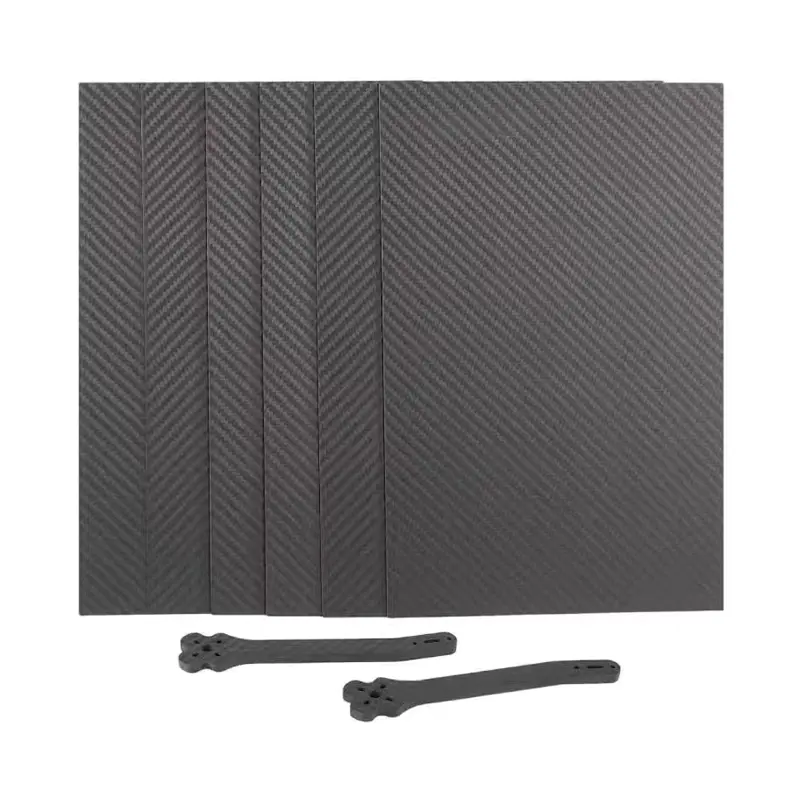
Lightweight Carbon Fiber Cloth is manufactured with reduced tow count and optimized weave geometry to achieve areal weights ranging from 60 to 120 g/m². This fabric class maintains a tensile strength above 3500 MPa while delivering a 40% mass reduction compared to standard 200 g/m² weaves. The open weave structure facilitates rapid resin penetration, making it suitable for vacuum infusion and resin transfer molding processes where low part weight is critical.
Primary Application Areas
Weight vs. Performance
Handling & Processing
- Infusion: Use low-viscosity epoxy (150–300 cP) to ensure complete wet-out without excessive pressure.
- Prepreg: Compatible with solvent-based impregnation; maintain resin content 30% – 34% for optimal tack.
- Drape: Lenowoven and satin variants offer superior conformability to double-curvature molds.
- Cutting: Die-cutting or CNC routing with diamond-coated tools reduces edge fraying.
- Storage: Store at 18–24 °C, ≤ 50% RH. Keep in original moisture-barrier packaging.
Test methods for areal weight, weave count, and sizing content applicable to lightweight carbon fabrics.
Frequently Asked Questions
Lower areal weight reduces fiber volume per ply, but also decreases void formation due to better resin flow. For equivalent layup thickness, use additional plies to achieve target fiber volume fraction (typically 50% – 55%).
Yes. The sizing is formulated for epoxy and phenolic matrices. For BMI or cyanate ester systems, request a specialized sizing formulation to maintain interfacial bond strength.
0.6 – 0.8 bar vacuum bag pressure is sufficient. The open weave permits rapid air evacuation, reducing cycle times in RTM processes.
Yes. FR-treated versions are available for interior aerospace and mass-transit applications, meeting FAR 25.853 and UL 94 V-0 requirements upon request.
 +86-13961668677
 No. 61, Xingyuan Road, Jiefang Village, Gushan Town, Jiangyin City, Jiangsu Province, China.