 Get In Touch
 English
 中文简体
 عربى
 Tiếng Việt

Content
A 3K carbon tow fails at roughly 1.5 percent strain. A 1000-denier para-aramid yarn woven beside it stretches to about 3.6 percent before it breaks. That gap is the whole commercial reason carbon aramid cloth exists: one fiber sets the stiffness of a laminate, the other decides whether the panel survives a dropped tool, a stone strike or a hard landing.
Hybrid reinforcement is not a compromise grade sitting between carbon and aramid. It is a designed material system, and it only performs when ratio, weave, sizing and resin are specified as one package. Miss one of those four and the aramid becomes dead weight that dilutes stiffness without adding measurable toughness.
What Carbon Aramid Cloth Actually Is
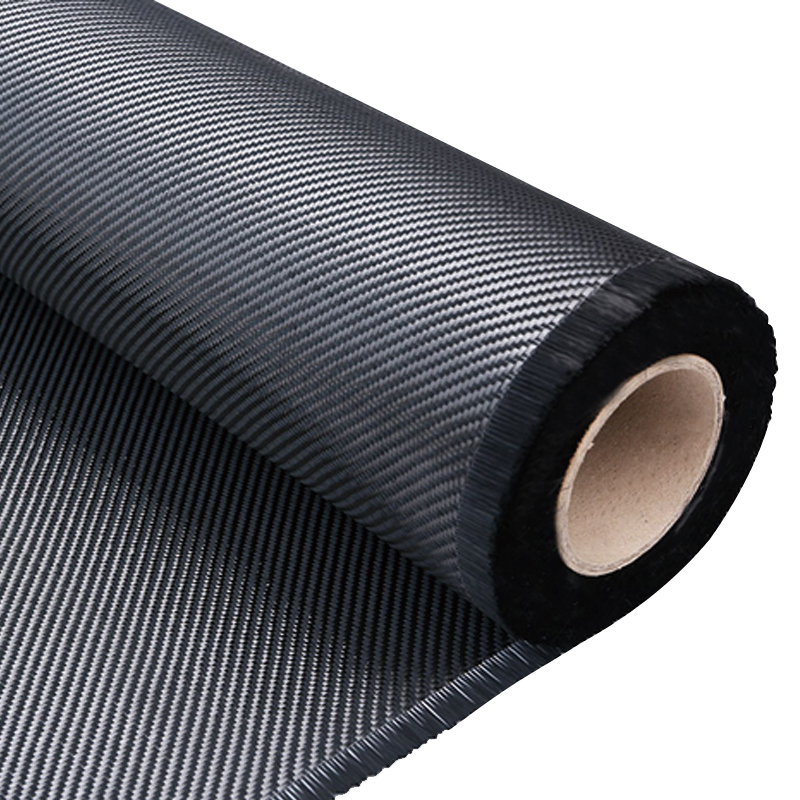
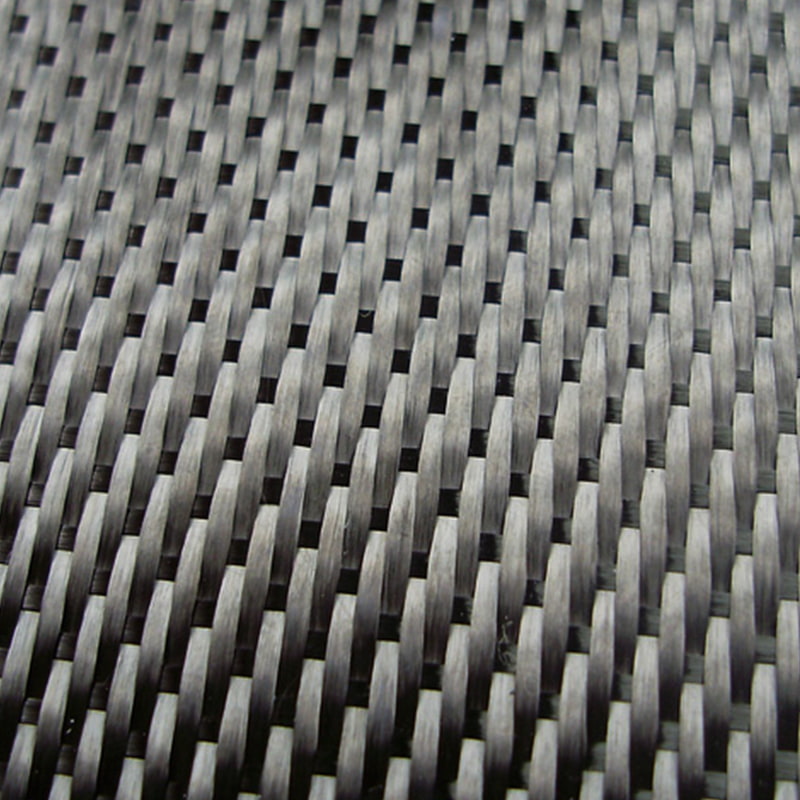
Carbon aramid cloth is a woven reinforcement that interlaces carbon tows and para-aramid yarns as two distinct warp and weft systems, usually 3K carbon with 1000D or 1500D aramid, so a single ply delivers both stiffness and impact tolerance.
The fibers are not blended at filament level. Each keeps its own yarn identity, and that is what makes the material predictable: the carbon grid forms the load path, while the aramid yarns sit inside the same ply where they can bridge cracks as they open.
Four variables decide how a given roll behaves on the tool:
- Ratio. The carbon-to-aramid mass share, set by yarn linear density and pick count.
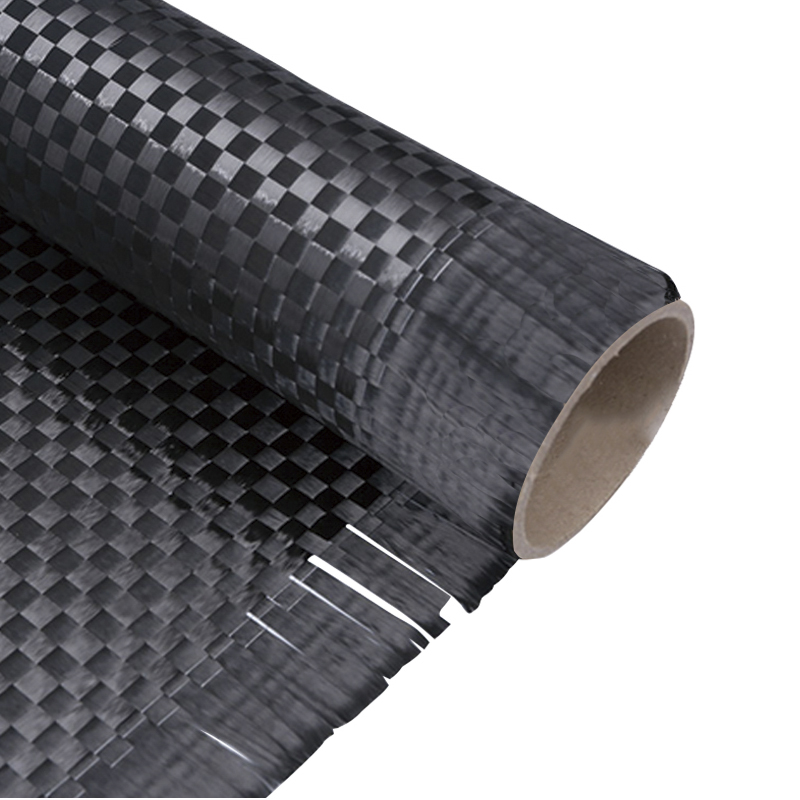
- Weave. Plain for maximum interlacing, twill for drape over curved tooling, satin for the flattest surface.
- Yarn size. 3K carbon against 1000D or 1500D aramid changes both areal weight and balance.
- Sizing. The carbon finish must match the resin chemistry, or the interface fails before the fiber does.
Carbon carries stiffness and compressive load while para-aramid absorbs impact energy and bridges cracks, and because the two fibers reach their limits at different strains, a hybrid laminate fails progressively instead of shattering at first-ply failure.
Under tensile load the carbon plies hit their 1.5 percent limit first. Aramid yarns in the same ply are only half stretched at that point, so they keep carrying load, hold broken carbon fragments in place and delay final failure. The same property explains the stacking rule: para-aramid compressive strength is a small fraction of its tensile strength, so aramid plies belong where they will be stretched, not where they will be crushed.
| Property | Standard-modulus carbon | Para-aramid | Effect in a hybrid laminate |
| Tensile modulus | 230 GPa | 70 to 112 GPa | Carbon sets stiffness; aramid adds little to it. |
| Strain to failure | About 1.5 percent | 3.4 to 3.8 percent | Aramid holds the ply together after carbon fails. |
| Density | 1.76 g/cm3 | 1.44 g/cm3 | A 55/45 build runs about 5 percent lighter than pure carbon. |
| Compression | Strong | A fraction of tensile strength | Keep aramid out of compression-critical plies. |
| Electrical | Conductive | Insulating | Partial electromagnetic shielding, not a full barrier. |
When a design needs the aramid behaviour on its own, a high-temperature-resistant and flame-resistant aramid woven fabric runs as a standalone ply, and it is also the reinforcement behind protective laminates that must self-extinguish.
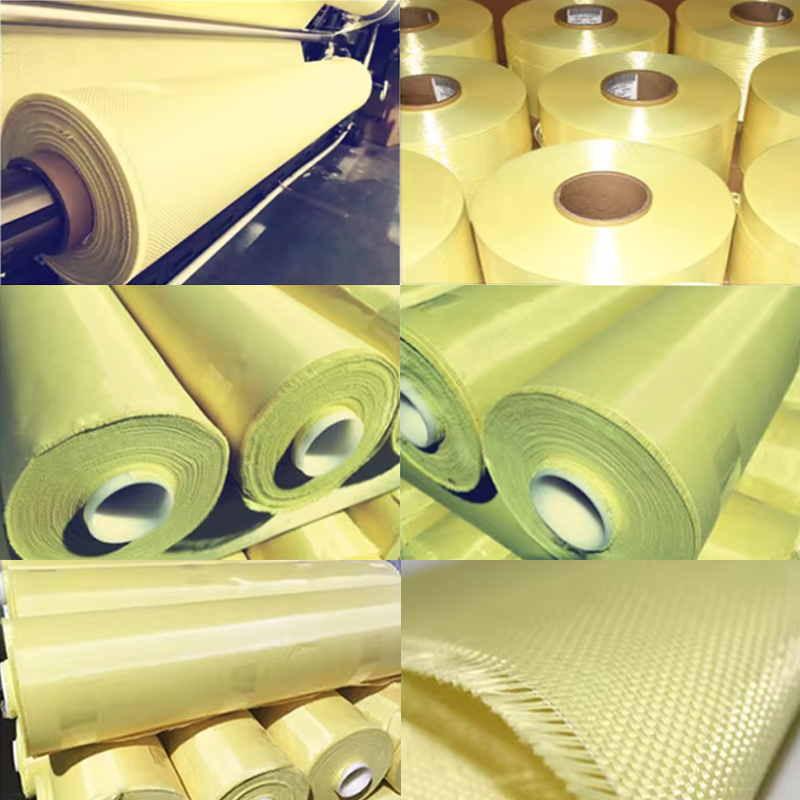 High Temperature Resistant And Flame Resistant Aramid Woven FabricThe High Temperature Resistant And Flame Resistant Aramid Woven Fabric is an industrial-grade textile engineered from synthetic para-aramid or meta-aramid fibers. This...View Product →
Choosing a Hybrid Ratio: 3K/1000D or 3K/1500D
In a balanced plain weave at equal pick counts, 3K carbon against 1000D aramid gives roughly 64 percent carbon by mass; switching the aramid to 1500D drops that to about 55 percent.
The arithmetic is short. A 3K carbon tow carries about 200 tex, meaning 200 grams per kilometer. Aramid is sold by denier, where 1000D equals roughly 111 tex and 1500D roughly 167 tex. Because a plain weave alternates both yarn systems in warp and weft, the mass share follows directly from those numbers, which is why ratio is a specification rather than a marketing claim.
| Build | Carbon share by mass | Typical use |
| 3K carbon / 1000D aramid, plain | About 64 percent | Stiffness-led skins and thin panels |
| 3K carbon / 1000D aramid, twill | About 64 percent | Curved parts that need drape |
| 3K carbon / 1500D aramid, plain | About 55 percent | Impact-led panels and underbody guards |
| 3K carbon / 1500D aramid, twill | About 55 percent | Thicker laminates with a visible weave |
The 3K plain and twill hybrid fabrics with 1000D or 1500D para-aramid cover most of that band and are woven to the required width and roll length.
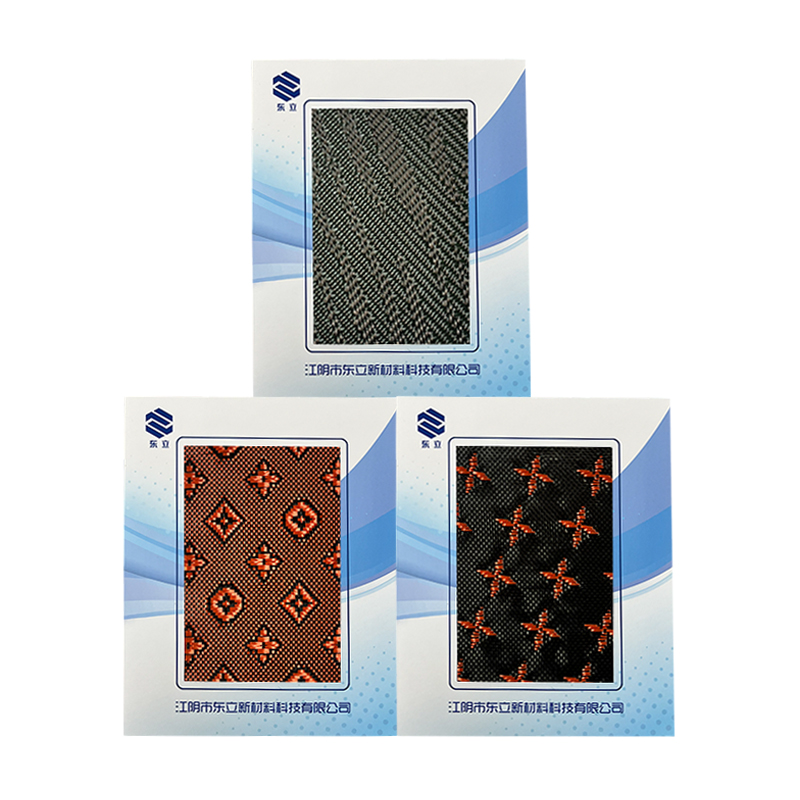 3k 1000d/1500d Plain/Twill Aramid Carbon Mixed Carbon Fiber Woven Fabric3K 1000D/1500D plain/twill aramid mixed carbon fiber woven fabric is made of aramid fiber and carbon fiber. Aramid fiber provides impact resistance and toughness, whil...View Product →
Resin, Wet-Out and Void Content
Para-aramid absorbs moisture and wets out more slowly than carbon, so hybrid laminates need dried fabric and a resin matched to the weave; production programs hold void content below 2 percent because each additional point of porosity cuts interlaminar shear strength.
As-received aramid can carry 3 to 5 percent moisture by weight after humid storage. That water turns to steam during cure and leaves voids exactly where the aramid-to-resin interface matters most. The control sequence is short and not optional:
- Dry the aramid-containing fabric at 80 to 100 degrees Celsius and record the weight loss.
- Confirm areal weight per square meter against the purchase specification before cutting.
- Match resin film weight to the fabric: a 200 g/m2 hybrid fabric pairs with about 100 g/m2 of epoxy film, giving roughly 33 percent resin by mass and close to 60 percent fiber volume.
- Hold aramid plies in a controlled-humidity layup room and stay inside the resin open time.
- Measure fiber content and void content by burn-off or digestion, never by visual inspection.
Epoxy covers most hybrid work. Cyanate ester enters when service temperature climbs: it absorbs less moisture and holds a much higher glass transition temperature, which keeps the aramid plies stable when a standard epoxy matrix would already be softening.
Epoxy prepreg matched to the weave, with resin film weight set against fabric areal weight, removes the wet layup variable and makes that void target repeatable.
 Epoxy Carbon Fiber PrepregCurrently, 70% of advanced composite products are made of prepregs that are stacked and cured. Prepregs are semi-finished products that are stored and prepared after f...View Product →
Where Hybrid Laminates Earn Their Cost
Carbon aramid cloth pays for itself in parts that take impact but still need stiffness: drone airframes and landing gear, automotive exterior and underbody panels, hockey sticks, paddles and protective enclosures.
- Impact or abrasion reaches the part in service
- A crack must not run from edge to edge
- The part is handled, dropped or struck daily
- Electrical isolation between carbon plies helps
- Stiffness per unit weight is the only metric
- The part is compression-critical
- Thermal cycling dominates the service load
- Ply cost is the deciding factor
The most practical technique is the sacrificial ply: one hybrid layer on the outer face, pure carbon underneath. The hybrid absorbs the strike, the carbon keeps the stiffness, and a repair becomes a single replaced ply instead of a scrapped part.
Specifying Hybrid Fabric on a Purchase Order
A usable hybrid specification states five things: areal weight with its tolerance, weave and yarn counts, sizing chemistry, roll width and length, and moisture content at packing.
- Areal weight in g/m2, with tolerance written as a percentage.
- Weave plus carbon tow size and aramid denier.
- Sizing system and its stated resin compatibility.
- Roll width, roll length and core diameter.
- Moisture content at packing and the packaging standard used.
Areal weight is verified under ASTM D3776 and width under ASTM D3774, so both numbers belong on the order as testable values rather than descriptions. A ratio drift of five percentage points between lots changes impact behaviour more than most buyers expect.
Jiangyin Dongli New Materials Technology Co., Ltd. weaves carbon, aramid and hybrid fabrics in a 32,000 square meter plant in Jiangyin, with constant-temperature weaving halls and a Class 100,000 cleanroom zone, running 10 production lines with 24 technical staff. The same site moves from woven fabric into prepreg and finished composite parts through autoclave, RTM, PCM and WCM processes, so a hybrid cloth can be woven, cured and tested inside one supply chain instead of three.
Practical Questions Before You Order
What carbon-to-aramid ratio gives the best impact performance?
For structural panels, 55 to 65 percent carbon by mass is the working band. Below about 50 percent carbon, flexural modulus falls faster than impact energy rises; above 70 percent, aramid no longer bridges cracks effectively and you pay hybrid prices for near-carbon behaviour. Verify the balance with ASTM D7136 drop-weight impact testing on a representative panel.
Does carbon aramid cloth run in standard epoxy prepreg?
Yes, when the resin film is matched to the fabric and the aramid is dried first. A 200 g/m2 hybrid fabric pairs with roughly 100 g/m2 of epoxy film for about 33 percent resin by mass and near 60 percent fiber volume. Undried aramid holding 3 to 5 percent moisture pushes void content past 2 percent and reduces interlaminar shear strength, measured under ASTM D2344.
How does the aramid side behave at high temperature?
Para-aramid does not melt. It chars and decomposes at around 500 degrees Celsius and carries a limiting oxygen index near 29, so it self-extinguishes in air. That behaviour is why the same aramid and hybrid fabrics appear in fire-resistant protective laminates as well as in stiffness-driven structural panels.
What should incoming inspection check on every hybrid roll?
Three measurements: areal weight per ASTM D3776 against the agreed tolerance, width and roll length against the packing list, and fiber content by burn-off or digestion to confirm the ratio. Because the two fibers differ in density, convert a mass-based ratio into volume fraction using 1.76 g/cm3 for carbon and 1.44 g/cm3 for aramid.
 +86-13961668677

 No. 61, Xingyuan Road, Jiefang Village, Gushan Town, Jiangyin City, Jiangsu Province, China.
