 Get In Touch
 English
  中文简体
中文简体 عربى
عربى Tiếng Việt
Content
A production supervisor once found 30 % of his FR-4 stock warped after a three-week stretch of 85 % humidity, because the sheets had been leaned vertically against a warehouse wall. Epoxy fiberglass laminates are dimensionally stable only when the storage environment controls moisture, temperature, and mechanical stress. The correct rule is simple: store sheets flat, keep the original moisture barrier intact, hold the room at 15–25 °C with 40–65 % relative humidity, and shield the material from direct sunlight.
How to store epoxy fiberglass sheet properly is a question every composite shop answers at the receiving dock, but most standards only regulate processing, not the months between delivery and use. At Jiangyin Dongli New Materials Technology Co., Ltd., a one-stop composite factory with a 32,000 m² base and a 100,000-class cleanroom, storage discipline is treated as part of product quality. The same climatic logic applies whether you buy 3240 plate from a domestic mill or G10 sheet from a global trader.
Epoxy fiberglass sheet is a thermoset laminate made from woven E-glass fabric and epoxy resin consolidated under heat and pressure; in Asian supply chains this material family is commonly identified as 3240, while the global equivalents are FR-4 and G10.
Why Storage Conditions Decide Sheet Performance
Moisture is the first and strongest enemy of epoxy fiberglass sheet: absorbed water lowers dielectric resistance, increases dielectric loss, and turns into internal steam during thermal processing, producing blisters and delamination.
A standard FR-4 laminate absorbs between 0.05 % and 0.10 % of its weight after 24 hours at 23 °C and 92 % relative humidity. At a storage RH consistently above 75 %, the surface resin slowly hydrolyses, the weave pattern can telegraph to the surface, and machined edges lose their clean breakout. Heat acts more slowly but just as destructively: prolonged exposure above 40 °C relaxes internal stresses and can reduce the effective glass-transition temperature of the finished board.
| Parameter | Recommended Range | Failure Mode |
| Ambient temperature | 15–25 °C | Warping, resin softening, higher internal stress |
| Relative humidity | 40–65 % RH | Moisture pickup, blisters, lower dielectric strength |
| Light exposure | No direct sunlight | Surface oxidation, discolouration, brittleness |
| Stacking position | Flat on supported shelves | Bending stress, permanent curvature |
| Packaging | Original PE/foil moisture barrier | Dust, moisture ingress, edge scratches |
Safe exposure time before re-conditioning drops sharply once humidity climbs above 65 % RH. The values below are practice thresholds for 1.6 mm FR-4 sheets, not a substitute for the supplier's own documentation.
If you see a glossy dark line under a stored sheet, that is not an oil stain; it is the first stage of resin degradation caused by one summer day of direct solar load through an industrial skylight. Trace the whole storage route, not just the shelf.
The Correct Storage Procedure, Step by Step
Store epoxy fiberglass sheets by following a six-step sequence: inspect, seal, lay flat, limit stack height, control climate, and rotate stock on a first-in, first-out basis.
- Inspect incoming sheets for edge damage, moisture marks, or curvature; reject any panel that arrives wet or with a crown of more than 2 mm over a one-metre length.
- Keep the factory moisture barrier intact. If a bundle has been opened, re-seal it in PE film with a silica-gel desiccant sachet within the same shift.
- Lay sheets flat on a wooden pallet or a steel shelf with a clean plywood cover. Never lean sheets against a wall and never place them directly on a concrete floor.
- Limit stack height to 300 mm or about twenty 1.6 mm sheets, so the bottom layers do not take compression marks from the weight above.
- Control the room climate with a digital hygrometer and thermometer, and log readings weekly. The acceptable band is 15–25 °C and 40–65 % RH.
- Rotate stock using first-in, first-out logic so that no panel waits longer than 24 months before being used or returned to the supplier.
Monthly witness test: keep one reference sheet in the same rack, draw diagonals on it, and measure them with a steel ruler. If the difference between the two diagonals grows by more than 2 mm, the storage climate has drifted outside the safe band.
Handling, Packing and Workshop Rules
Handle epoxy fiberglass sheets with clean gloves, keep machined surfaces away from airborne dust and coolant mist, and re-seal any opened bundle within minutes of handling.
- Wear clean cotton gloves; skin oils contaminate the surface and weaken the bond in later lamination or copper-clad processing.
- Deburr edges after cutting; sharp glass-rich crumbs scratch the face of the sheet underneath when you stack them again.
- Never drag one sheet across another; hard glass fillers create micro-scratches that become crack origins under cyclic loading.
- Do not store near grinding or sanding stations; conductive graphite dust from other composite work contaminates electrical-grade boards.
- Re-wrap partially used bundles in PE film with a desiccant sachet and tape the marked grade, thickness, and batch number to the cover.
Correct practice
- Flat on perforated steel shelves
- Sealed original packaging
- 40–65 % RH, 15–25 °C
- Maximum stack 300 mm
- Monthly humidity log
Common failure
- Vertical racks with edge support only
- Open bundle facing a gangway
- Above 75 % RH and near a wash bay
- Heavy steel dies placed on top
- No record of batch age
Resin-based materials with a defined out-life follow the same climatic logic. If your plant also works with prepreg, treat the epoxy prepreg storage out-life guide as the reference for the un-consolidated side of the family.
If a sheet has been stored above 65 % RH for more than seven days, do not send it straight to a hot process. Bake it for 2–4 hours in a circulating oven at 60–80 °C, then cool to below 35 °C inside the oven before machining or lamination.
Shelf Life, Drying and Pre-Use Checks
A correctly stored epoxy fiberglass sheet holds its mechanical and electrical properties for at least 24 months; sheets that have absorbed moisture must be dried before thermal processes, not before simple drilling.
Panels that stayed sealed and flat for two years normally do not need conditioning. Panels that were exposed or stored above 65 % RH should pass through the 60–80 °C baking cycle described above. Never bake above 100 °C unless the grade is documented for it; over-baking produces warp and resin brittleness that cannot be reversed.
For electrical insulation, battery fixtures, and PCB clamps, Jiangyin Dongli supplies a UL94 V0-rated epoxy fiberglass insulation plate in the 3240 family, flat-packed and edge-protected from the same plant where the glass fabrics and prepreg are made.
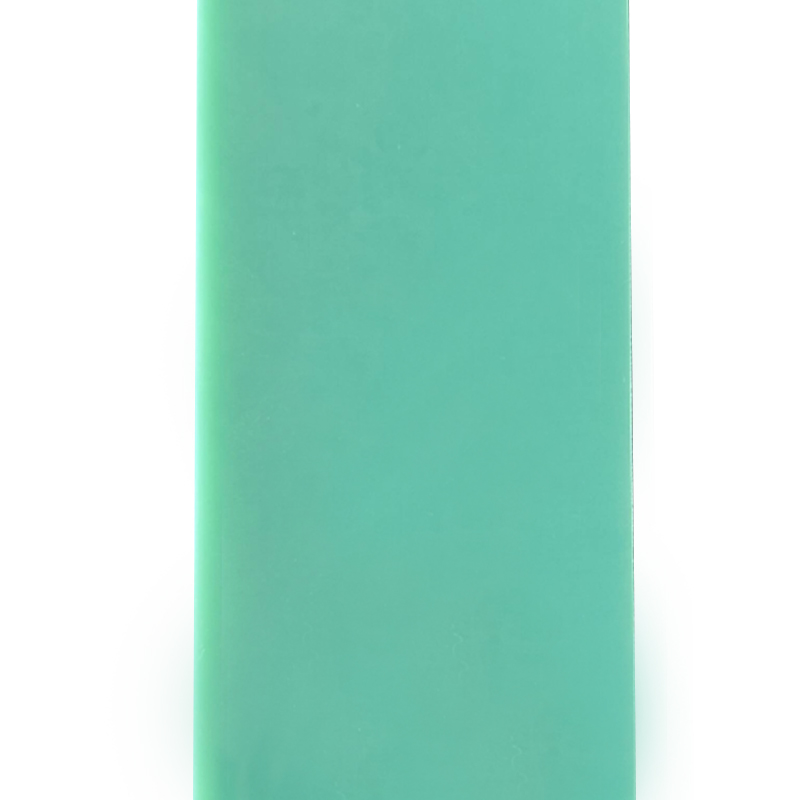 UL94 V0 Epoxy Fiberglass Insulation Board for Electrical UseThis flat-packed epoxy glass laminate offers high arc resistance and moisture stability, making it a reliable choice for insulation fixtures and PCB clamps where long-term performance matters.View Product →
The dominant ageing factor in epoxy glass laminates is humidity, not calendar time. A sheet that has lived for 24 months in a sealed, flat, temperature-stable store will machine and insulate the same as a fresh panel.
Frequently Asked Questions
Can epoxy fiberglass sheets be stored vertically?
No. Vertical storage creates permanent bowing because the sheet's own weight acts on a thin edge. Even a 1.6 mm sheet will creep, and edge-supported racks concentrate stress exactly where delamination starts.
How long can epoxy fiberglass sheets be stored?
At least 24 months when the sheet is sealed in its original moisture barrier and kept flat at 15–25 °C with 40–65 % RH. After that period, re-check flatness, surface gloss, and edge colour before processing.
What humidity level damages FR-4 sheets?
Sustained humidity above 65 % RH is the practical boundary. Above 75 % RH, surface hydrolysis accelerates and the sheet may begin to absorb enough moisture to require a full drying cycle before lamination or soldering processes.
Do I need to dry sheets before machining?
Only if they have been exposed to high humidity or removed from the packaging for more than a few days. If you have any doubt, bake at 60–80 °C for 2–4 hours; simple drilling rarely needs it, but thermal processes do.
Keep it flat, keep it dry, and keep it cool. That one rule preserves the dielectric, mechanical, and machining performance of every epoxy fiberglass sheet in the plant.
 +86-13961668677
 No. 61, Xingyuan Road, Jiefang Village, Gushan Town, Jiangyin City, Jiangsu Province, China.