 Get In Touch
 English
  中文简体
中文简体 عربى
عربى Tiếng Việt
Content
- 1 What Makes an Epoxy Fiberglass Sheet a Dielectric Barrier
- 2 Key Electrical Insulation Properties to Evaluate
- 3 Thermal and Mechanical Factors That Affect Long-Term Insulation
- 4 Where Epoxy Fiberglass Insulation Sheets Are Used
- 5 How to Choose the Right Epoxy Glass Fiber Sheet
- 6 Why Full-Process Control Matters for Insulation Sheet Quality
- 7 Final Recommendation
An epoxy fiberglass sheet is often the quietest part in a high-voltage assembly. It sits between a live bus bar and a metal enclosure, underneath a printed circuit board during electrical testing, or inside a lithium battery pack where small tolerances leave little room for error. Its job is simple: keep current on the path it was designed for. When the sheet works, nothing happens. When it fails, you get arcing, tracking, or a total insulation breakdown.
The reason this material works so well is that it is a true dielectric laminate. Glass fiber reinforcement provides high resistance to current flow and a stable structure that can handle heat. The cured epoxy resin binds those glass layers into a dense board, fills the spaces between fibers, and blocks the moisture and contamination that would otherwise create leakage paths. Together, the two materials create a barrier that is greater than the sum of its parts.
What Makes an Epoxy Fiberglass Sheet a Dielectric Barrier
Two elements share the insulating job. The glass layers contribute heat resistance, dimensional stability, and very high volume resistivity. The epoxy matrix holds the glass fibers in a fixed position, protects them from humidity and mechanical damage, and supplies the surface resistance that keeps current from tracking across the sheet.
From an electrical design perspective, the sheet acts like a parallel-plate dielectric between two conductors. The voltage it can withstand before breakdown is governed by its thickness, resin quality, void content, and surface condition. That is why a laminate produced under controlled conditions, with even resin coverage and minimal voids, behaves more predictably than a board that traps air or contains resin-rich and resin-poor zones.
Design teams already familiar with epoxy-based composite performance recognize the same pattern in insulation boards: the resin system controls most of the electrical behavior, while the reinforcement controls mechanical stability.
Key Electrical Insulation Properties to Evaluate
Not every insulation sheet is selected the same way. Voltage class, frequency, operating temperature, and surrounding contamination all change the specification. The table below lists the properties that matter most when an epoxy glass fiber sheet is being used for electrical insulation.
| Property | What it indicates | Why it matters |
|---|---|---|
| Dielectric strength | Voltage a laminate can withstand without breaking down | Sets the minimum thickness for a specific voltage stress |
| Volume resistivity | Resistance to leakage current through the laminate | Keeps the energized conductor electrically isolated |
| Surface resistivity and CTI | Resistance to tracking on the sheet surface | Prevents conductive carbon paths under contamination and humidity |
| Water absorption | Amount of moisture absorbed into the laminate | Moisture lowers resistivity and can accelerate surface tracking |
| Thermal class | Continuous operating temperature limit | Prevents softening, delamination, or loss of insulation over time |
| Flame rating | Behavior when exposed to fire | Supports safety requirements such as UL94 V0 |
Why CTI Matters in Polluted Environments
Comparative tracking index is more than a test number. In switchgear, battery compartments, and industrial controls, dust and condensed moisture can settle on the surface. A conductive track can form if leakage current carbonizes the resin, creating a permanent fault path that cannot be cleaned away. A sheet with good tracking resistance keeps the surface safe even when contamination is present.
Why Moisture Works Against Insulation
Water molecules absorb onto the glass surface and can dissolve ionic contamination, lowering both surface and volume resistivity. Under high voltage, that drop in resistance encourages tracking and can reduce dielectric strength. Low water absorption in the cured laminate helps preserve the sheet’s insulation performance over years of service.
Thermal and Mechanical Factors That Affect Long-Term Insulation
Electrical insulation is often evaluated at room temperature, but the real test happens when the assembly is hot, tightly clamped, and exposed to continuous vibration. The glass reinforcement and the cured epoxy matrix work together to keep the laminate electrically stable under those conditions.
Heat Resistance and Flame Retardance
High-current busbars, transformers, battery cells, and motor windings all generate heat. A good epoxy glass fiber sheet maintains its mechanical and electrical properties at elevated temperatures, while the glass layers keep it dimensionally stable. When the resin system also meets UL94 V0, the sheet satisfies stricter safety requirements in battery packs, chargers, and electronic equipment.
Mechanical Strength and Machinability
The sheet does not just sit in place. It is punched to create terminal holes, milled into brackets, cut into PCB fixtures, or clamped between busbars. Glass reinforcement gives the laminate flexural strength and resistance to creep, while the epoxy matrix keeps edges clean during machining. A sheet that chips, fuzzes, or delaminates when cut creates weak points that can fail later in the field.
Dimensional Stability Under Clamping
Spacers and barriers are often stacked between conductors and metal parts. A warped or over-thick sheet can loosen connections; an under-thick sheet can reduce the required safety distance. Controlled thickness tolerance and low residual stress are therefore not cosmetic details. They help guarantee that the insulation barrier stays exactly where it was designed to be.
Where Epoxy Fiberglass Insulation Sheets Are Used
The combination of electrical, thermal, and mechanical properties makes this laminate a practical choice in a wide range of equipment:
- Lithium battery modules, where thin insulation spacers separate busbars from the enclosure and from adjacent cells.
- PCB test fixtures, where a high-resistance platform holds boards during high-voltage probing and in-circuit testing.
- Electrical equipment such as switchgear, transformers, motor controls, and terminal blocks that need flame-retardant barriers and mounting parts.
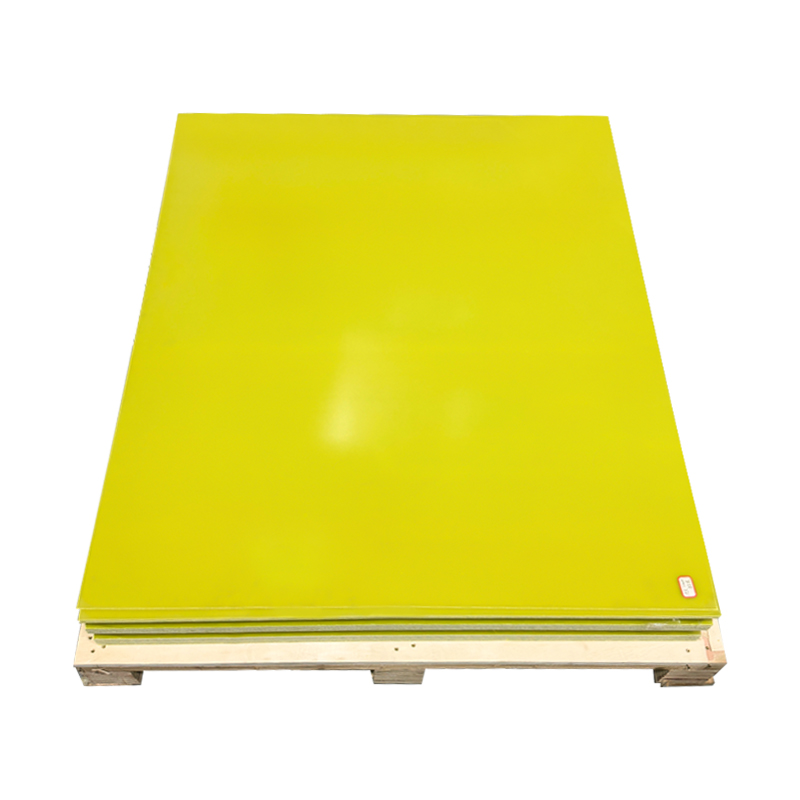
Dongli’s epoxy fiberglass insulation plate is manufactured for these applications with a flame-retardant epoxy resin system and can be supplied in custom cut sizes.
 Custom Epoxy Resin Glassfiber Insulation Board Manufacturers, FactoryWe Offer Custom Epoxy Resin Glassfiber Insulation Board, Jiangyin Dongli New Materials Technology Co., Ltd Is China Epoxy Resin Glassfibe...View Product →
How to Choose the Right Epoxy Glass Fiber Sheet
The most reliable way to select an insulation board is to start with the limiting condition, which is usually voltage, temperature, mechanical loading, or a safety requirement such as flame rating.
- Confirm the working voltage and the required electrical clearance, then determine the minimum thickness.
- Note the maximum continuous operating temperature and whether short over-temperature spikes are expected.
- Define the manufacturing process: punching, drilling, milling, sawing, or die-cutting.
- Assess the environment for humidity, dust, condensation, and potential contamination.
- Request data for dielectric strength, volume resistivity, surface resistivity, CTI, water absorption, thermal class, and thickness tolerance.
These values should be checked with the same rigor used for testing standards for composite laminates, because an insulation failure is usually invisible until it has already caused a fault.
Why Full-Process Control Matters for Insulation Sheet Quality
The difference between a reliable insulator and a risky one is often not the raw material but the production process. Voids, uneven resin distribution, dust, and thickness variation create weak spots that are not visible during visual inspection. They show up later as reduced dielectric strength, tracking, or premature failure under load.
Dongli produces insulation sheets in a 32,000 m² factory with constant-temperature workshops and 100,000-class clean areas. Full-process control also includes weaving, resin mixing, lamination, and final inspection, so the sheet remains consistent from one batch to the next.
That same discipline is what makes carbon fiber composite panel engineering successful in structural parts: the laminate is only as good as the control over its layers.
Final Recommendation
Epoxy fiberglass sheet provides electrical insulation because it combines a high-resistivity glass structure with a dense, moisture-resistant epoxy matrix. The sheet resists current flow, surface tracking, heat, mechanical stress, and the long-term effects of humidity. To specify it correctly, anchor the design to measurable requirements: dielectric strength, resistivity, CTI, water absorption, thermal class, flame rating, thickness tolerance, and machining quality.
When those values are confirmed and the manufacturing process is controlled, the sheet will do exactly what it is meant to do: hold the voltage, resist heat, and stay reliable for the life of the equipment.
 +86-13961668677
 No. 61, Xingyuan Road, Jiefang Village, Gushan Town, Jiangyin City, Jiangsu Province, China.